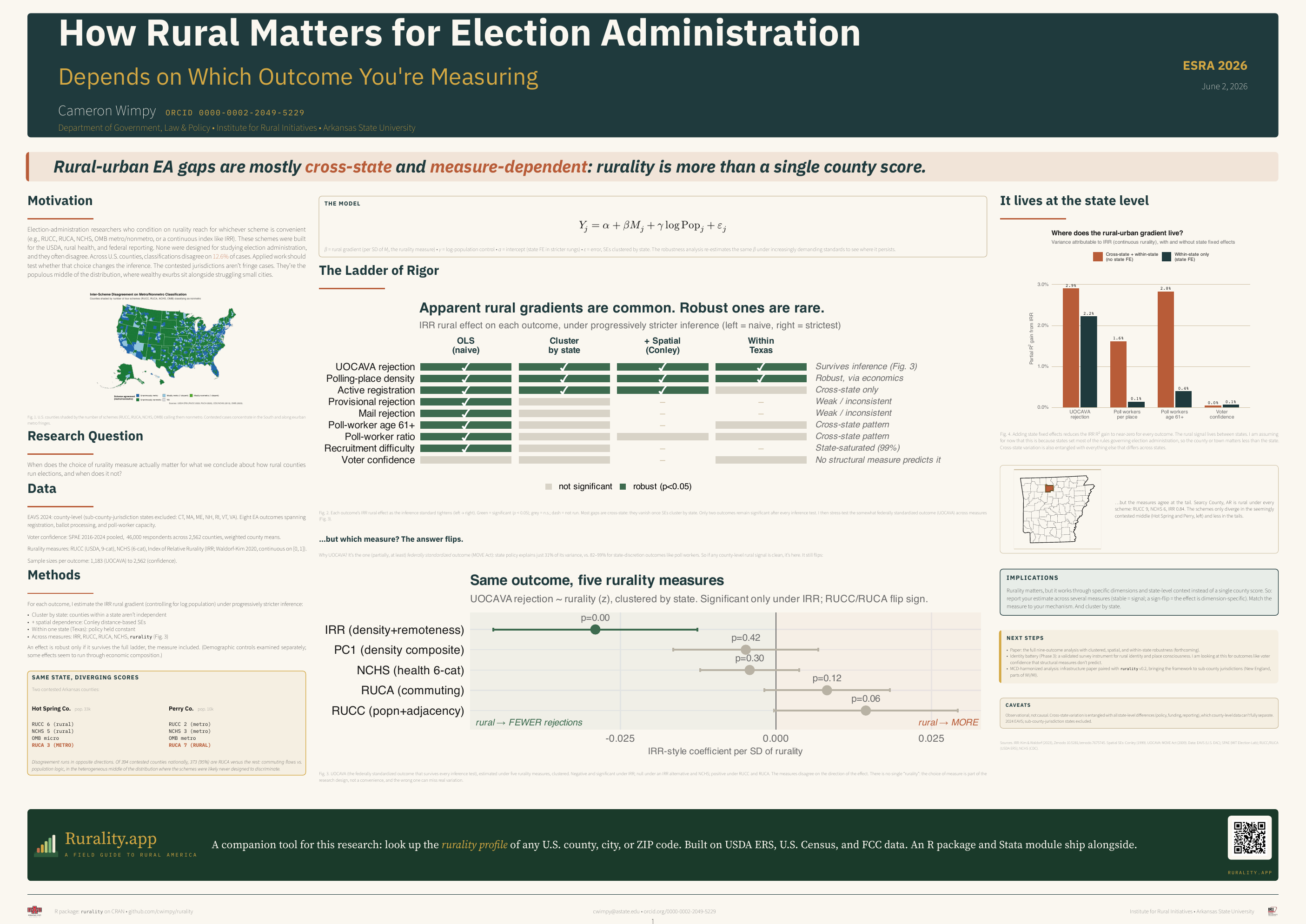
How does rural matter for election administration?
5 min
Jun 2, 2026

I am associate professor of political science and chair of Government, Law & Policy at Arkansas State University with interests in comparative public administration, election administration, political economy, political methodology, and rural public policy. Since 2022, I have also served as the founding director of the Institute for Rural Initiatives. I am an affiliate faculty with the Arkansas Biosciences Institute at A-State.
I formerly served as the Research Director in the MIT Election Data and Science Lab, where I managed applied research on the scientific study of elections. I was previously an affiliate faculty member with the Harvard Institute for Quantitative Social Science. I grew up on Crowley’s Ridge in the Arkansas Delta.
Featured · New
Drawing on interviews with local election officials across 17 counties in six states, this study traces how rural election administration actually runs in the Delta. We elucidate the communication gaps left by shrinking local media, the fight to recruit poll workers amid population decline, the vote-by-mail and bipartisan-balance challenges. We also discuss the quieter advantages of small populations, high local trust, and strong federal and state support.

Less than one-fifth of the voting-age population lives in rural areas, yet nearly two-thirds of U.S. elections are administered in rural jurisdictions.
From the Institute · Current work
Of 3,219 U.S. counties, 553 became more rural and 184 became less rural over the past decade, as measured by USDA’s Rural–Urban Continuum Codes. Counties shade darker for higher RUCC; arrows mark every county whose code changed.
In progress
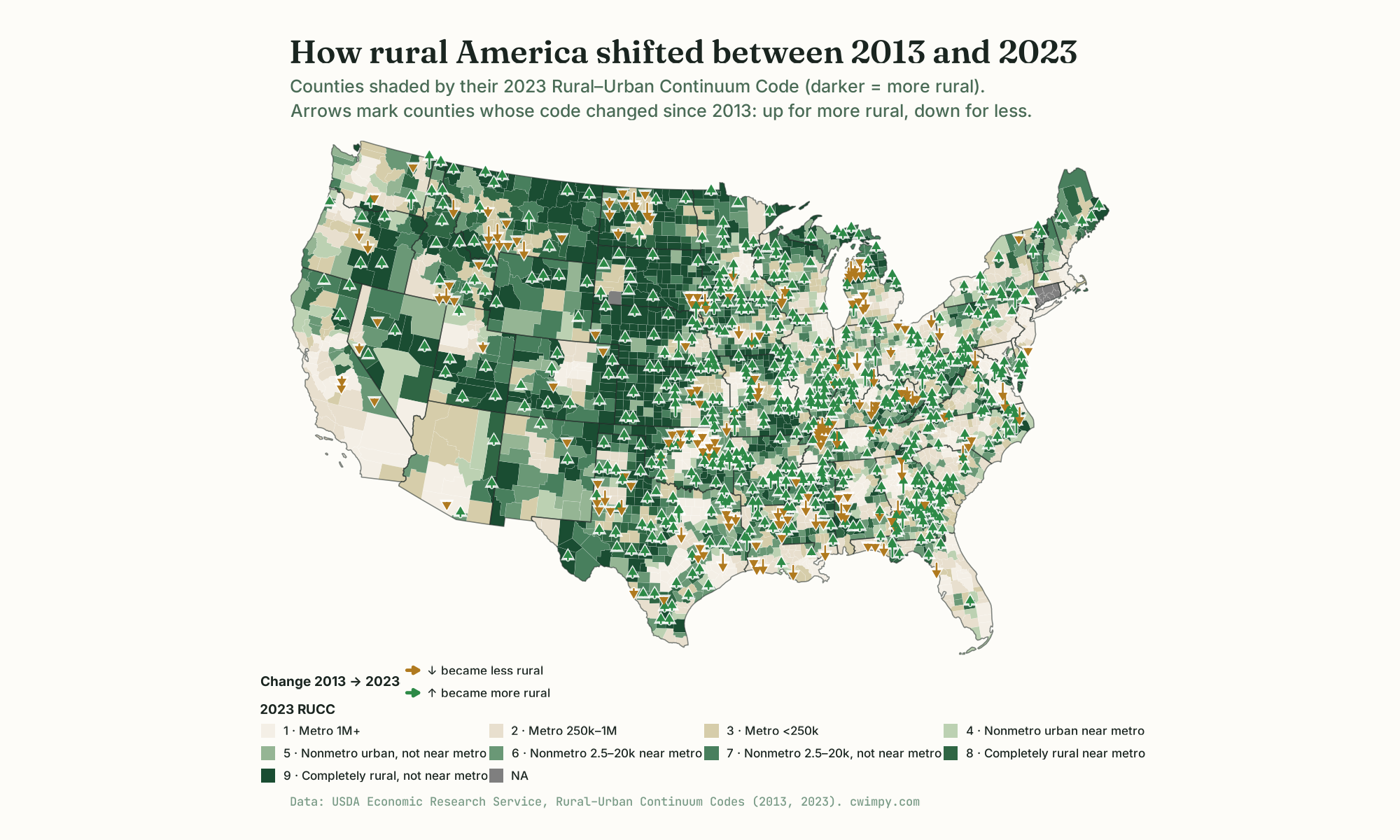
Data: USDA Economic Research Service, Rural–Urban Continuum Codes (2013, 2023). Source: scripts/rucc-map.R. Last rendered: April 2026.